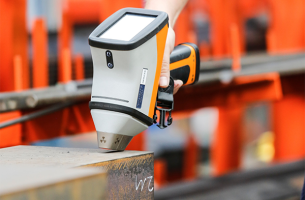
Bunting uses Hitachi’s X-MET8000 handheld XRF analyzer to provide fast, accurate elemental analysis of materials. The technology has reduced testing and recommendation times from months to hours, improved customer reporting, supported equipment selection, and enabled incoming material inspections. Ultimately, it has enhanced laboratory services, efficiency and customer confidence.
Bunting designs and manufacturers an extensive range of magnetic separators, eddy current separators, metal detectors, and electrostatic separators. The laboratory team uses Hitachi’s X-MET8000 Expert Geo handheld XRF analyzer for a comprehensive elemental analysis to enable technicians to make detailed and accurate recommendations on magnetic separation and detection to assess the feasibility of projects, propose process flowsheet options to customers, and confirm the separation and detection abilities of recommended Bunting equipment.
Prior to purchasing the X-MET8000, samples would be tested and returned to the customer for analysis and feedback. Bunting purchased Hitachi’s X-MET8000 Expert Geo handheld XRF analyzer primarily to enhance the laboratory testing service provided at their Customer Experience Centre in Redditch, UK. Phil Tree, Technical Sales Manager, said, “The X-MET8000 has given us a much more professional approach and it has promoted our laboratory to another level.”
Undertaking the analysis in the laboratory reduces the time between testing and equipment recommendation by weeks and, when working on overseas projects, by months. A typical process of testing and analysis now takes between two to three hours for one particular sample, reducing the time scale for processing from one or two months to a day at the most. “The X-MET8000 has changed the way we undertake laboratory test work,” explained Professor Neil Rowson, Laboratory Manager. “It enables the fine tuning of our tests, and the easy and quick communication of results to our clients. This has significantly shortened the time between testing and the placing of an equipment order. We are also seeing an increase in demand for testing as potential customers learn about our capabilities.”
As a leading global supplier of high-intensity magnetic separators, electrostatic separators and eddy current separators for the mineral processing and recycling industries, Bunting receives material samples from mineral processing, mining and recycling companies from across the world for controlled tests by technicians for separation and detection. The X-MET8000 delivers exceptionally quick results which enables laboratory staff to understand how materials behave when testing on magnetic separation and electrostatic separators. The X-MET8000 enables the analysis of metal, mineral and soil samples by identifying elements such as Mg, Al, Si, P, S, Fe. Adjustments to operating parameters such as belt speed, splitter position and capacity are assessed using the X-MET8000, leading to selection and recommendation of the optimum separator and performance criteria. Professor Neil Rowson, Laboratory Manager, explains “For a typical test sample, like silica sand that is being used in the fibre optic industry and has to be very clean, a customer will send us the raw material and we will process it over high intensity magnetic separators which will remove the weakly magnetic particles and give us a clear non-magnetic product. I will then test those products for iron level and if the percentage meets their specification then we have a process that will work for them.”
After looking at a number of handheld XRF manufacturers, Bunting-Redditch decided to buy Hitachi’s X-MET8000 Expert Geo for a number of reasons. Professor Neil Rowson, Laboratory Manager adds, “One was its technical specification, also it’s ability to generate both excel and PDF results spreadsheets that makes my report writing a lot easier. The other thing I liked about it was the level of technical support, both at the sale stage and more importantly after we purchased it as well. My experience with the Hitachi X-MET8000 has been all positive.”
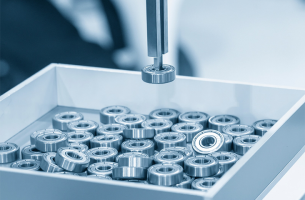
The X-MET8000 is easy to use and very easy to set-up. It’s also portable around the site, so although the X-MET8000 was purchased for the laboratory, the analyzer is also frequently used in incoming inspection to check incoming goods for the specification of critical materials and stock control of new metals. Bunting’s extensive range of separation and detection equipment often requires a specific grade of stainless steel or other metal. On receipt in goods inwards, Bunting’s storeman is able to quickly check and verify the material specification. “Hitachi’s X-MET8000 has been a great investment,” said Adrian Coleman, the General Manager. “The X-MET8000 has helped secure new orders and with the subsequent manufacture of equipment.”
There are a range of methods for achieving accurate metal analysis. If you require fast, non-destructive alloy identification and elemental analysis, handheld XRF’s like the X-MET8000 are a great option to use on site. On the other hand, laboratory OES analyzers can give more accurate results but require a lab sample which can take longer to process.
Handheld XRF is highly accurate for identifying and verifying many metal alloys when the sample is clean, the instrument is properly calibrated, and the elements of interest are within its measurement capabilities. It is widely used for positive material identification (PMI), scrap sorting and foundry quality control.
The best tool depends on whether you want to determine a metal's chemical composition, internal defects, hardness or coating thickness. Our handheld XRF analyzers are best for alloy identification, especially in stainless steel, nickel alloys, copper alloys and many other metals.